
Blue and white are among the most recognisable combinations in traditional Chinese textiles. Yet fabrics that look alike may have been made by quite different processes. A deep-blue wrapping cloth with pale cranes, a narrow cotton length with printed flowers, and a handwoven check should not automatically be assigned to the same technique.
Blue printed cotton describes an appearance. Paste-resist printing identifies a particular process.
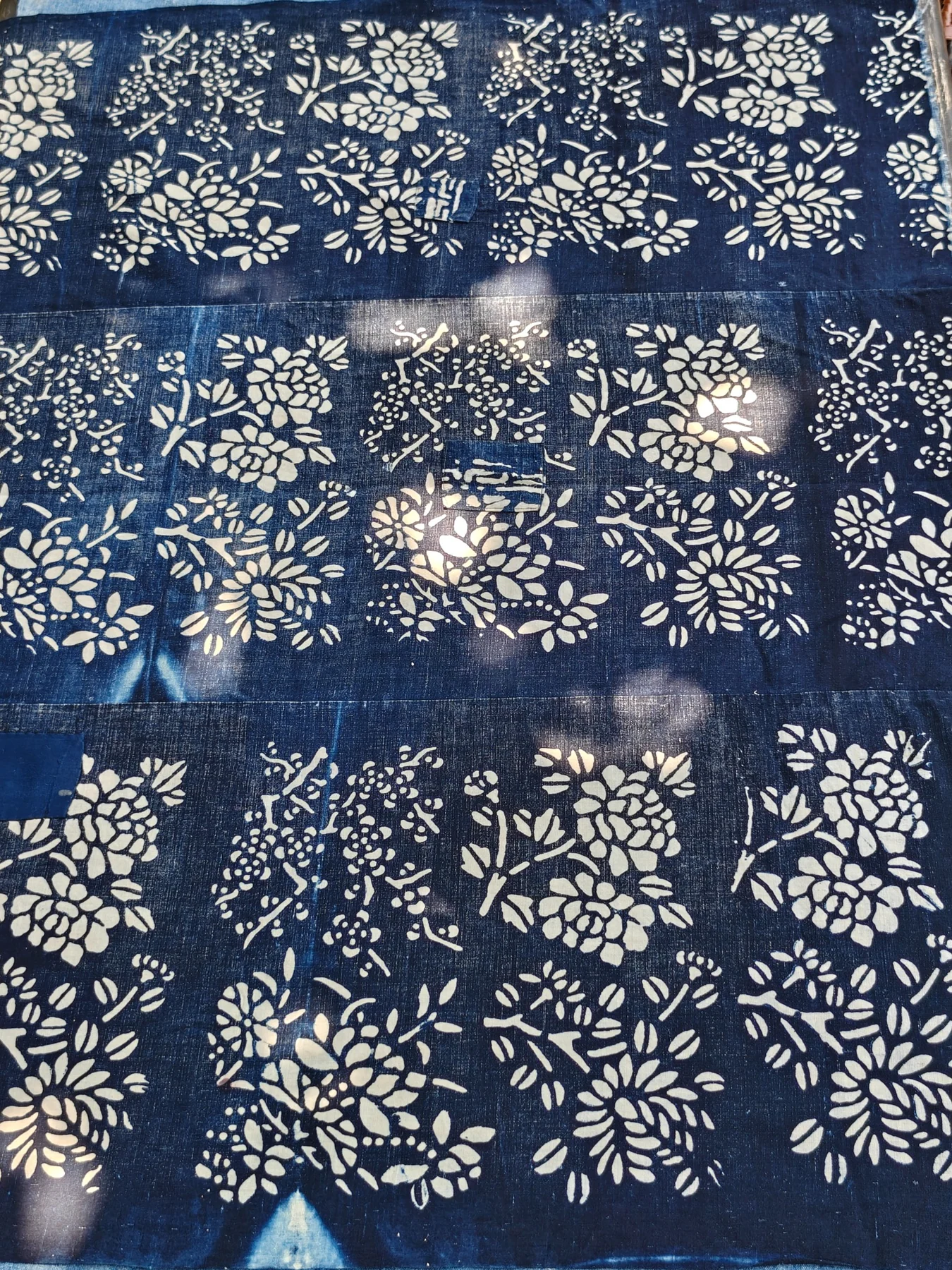
1. Lan Yin Hua Bu: A Documented Resist-Dyeing Tradition
Nantong, Jiangsu, is closely associated with lan yin hua bu (蓝印花布), a traditional blue-and-white paste-resist cloth. In this process a prepared stencil guides the application of resist paste to woven cotton. The cloth is subsequently dyed, and the resist is removed to reveal light motifs against blue. The book Nantong Tubu discusses blue printed cloth, its production, and the region's broader textile history (Jiang Ping, 2012, printed pp. 94–98).
The pale shapes are not woven into the ground. They are produced by preventing dye from reaching selected areas. This technique may create floral, geometric, figurative and auspicious compositions. Nor should the English label “indigo” automatically be taken to verify the chemical origin of the dye used in an individual surviving object.
2. Not Every Blue Print Can Be Identified as Resist Printing
“Blue printed cotton” is a useful descriptive phrase for a textile with a blue-and-white printed surface when its manufacture is undocumented. Nantong's textile story also includes coloured printed cloth, discussed alongside blue printed cloth in Nantong Tubu. Historical examples may reflect different materials and stages of production.
But the existence of several traditions does not establish whether a specific old fabric was printed using a hand stencil, a block, a roller, or another method. The two books cited here do not establish the precise printing equipment used to make every narrow-width vintage floral cotton in our collection. We therefore avoid identifying unknown prints as either roller-printed or stencil-printed without additional evidence.
For a closer regional overview, read Nantong Printed Cottons: Indigo Resist, Colour Printing and a Regional Textile Tradition.
3. First the Weave, Then the Print
Tubu (土布) refers to traditional homespun or locally woven cotton. Its construction is a different question from the technique used to decorate it. A handwoven ground might later receive a printed surface, while an elaborate blue design alone cannot prove that the fabric was handwoven.
Research on Jiangnan Homespun Textile Patterns (2024) documents woven structures and classifications of geometric, natural and symbolic motifs. These examples are valuable for describing the vocabulary of cloth, but a woven motif is not evidence of how a superficially similar printed motif was made.
Our guide to Tubu explains how woven construction, regional traditions and household use fit together.
4. What the Reverse Side Can—and Cannot—Tell Us
Looking at both sides of a vintage textile can reveal colour penetration, yarn texture, seams and historic repairs. Some blue designs remain obvious on the reverse; others appear faint. Softness, uneven outlines and the degree of penetration can be useful physical observations.
None is a standalone dating test. Modern traditional resist dyeing can also penetrate the cotton, while age, finishing, fibre and different printing materials affect appearance. We treat the reverse side as one clue among several rather than proof that a textile is old or that a particular tool was used.
5. Repeats, Stencils and the Question of Local Workshops
A repeating floral design does not, by itself, identify its printing machinery. Both hand-applied and mechanically printed cloth can display regular repeats, while small changes in alignment, pressure, dye application or wear can appear in different processes.
Oral accounts sometimes associate individual historic patterns with particular villages or workshops. This is a promising subject for future research, but without identifiable records of a workshop, stencil or maker we cannot assign such an origin to a particular cloth. Surviving tools, village histories and documented collections may one day provide firmer answers.
6. Cloth for Daily Life, and Patterns with Meaning
Printed cotton was used for practical household textiles such as wrappers, clothing and bedding. A finished wrapping cloth might preserve narrow joined panels, fastening ties, fold marks and patches. These are material clues to its earlier life.
Decorative motifs may evoke longevity, prosperity, harmony and continuity: cranes, peaches, flowers and curling vines all have established associations in wider Chinese decorative culture. Particular identifications should remain cautious when a stylised image or its original context is uncertain.
7. Preserving What We Know—and What We Do Not
At Tubu Atlas, we record the observed structure of each cloth separately from its printing method, date and place of origin. Where a process is documented, we describe it. Where the evidence remains incomplete, we prefer “vintage Chinese printed cotton—printing method unverified.”
Modern reproductions keep patterns accessible, while surviving old fabrics bear their own distinctive histories of weaving, printing, use and repair. The value of a textile does not depend on assigning it an impressive but unverified technique.
A textile can be beautiful, historic and worthy of preservation even when its printing method remains an open question.
Explore Related Textiles
See the indigo resist-printing collection for documented catalogue examples, or explore Nantong printed cotton across different objects. Our shop contains available vintage pieces; descriptions of individual textiles identify uncertainty where appropriate.
References and Research Notes
Jiang Ping (姜平), Nantong Tubu: The Roots of Jianghai Farming and Weaving Culture (《南通土布——江海耕织文化之根》), Soochow University Press, 2012. See the sections on textile varieties and blue and coloured printing, especially printed pp. 94–98 (scanned PDF pp. 124–128).
Research on Jiangnan Homespun Textile Patterns (《江南土布纹样研究》), China Textile & Apparel Press, 2024. See chapters on woven structures, natural motifs and geometric motifs. These concern woven patterns and are not proof of a specific printing technique.
Evidence note: these works document textile traditions and categories, not the exact manufacturing history of each textile in our collection. Village-specific attribution, exact machinery, and dye composition require further corroboration.