
Nantong, on the northern side of the Yangtze estuary in Jiangsu, developed one of eastern China’s most important cotton-textile traditions.
Its textile history was never limited to weaving alone.
Cotton cloth could be used in its woven state, but it could also move into another stage of production: dyeing and printing. Among the best-known results is Nantong’s blue-and-white resist-printed cloth, usually referred to as lanyin huabu (蓝印花布), or blue calico.
Yet blue resist is only one part of Nantong’s printed-cloth story.
By the twentieth century, the regional world of printed cotton also included changing workshop and factory technologies, multiple-colour printing and new floral designs.
For the Tubu Atlas, it is therefore useful to separate three related but different things:
the woven ground cloth, the printing or dyeing technique, and the finished printed textile.
Cloth First, Print Second
A printed cotton begins with cloth.
That distinction matters when studying surviving Chinese textiles.
Nantong developed within a wider cotton economy that connected cultivation, spinning, household weaving, merchants and regional markets. A piece of cloth could therefore have a history before printing was ever added to its surface.
Printing did not replace the woven foundation. It transformed it.
A light cotton ground might be patterned through resist and indigo dyeing. Other printed textiles, especially later examples, could use several colours or different methods of surface decoration.
When looking at an old printed textile, two questions therefore need to be kept separate:
How was the ground cloth made?
and
How was the pattern added?
The answers may belong to different stages of production.
Blue Calico: Nantong’s Best-Known Printed Cloth
The printed textile most strongly associated with Nantong is blue calico.
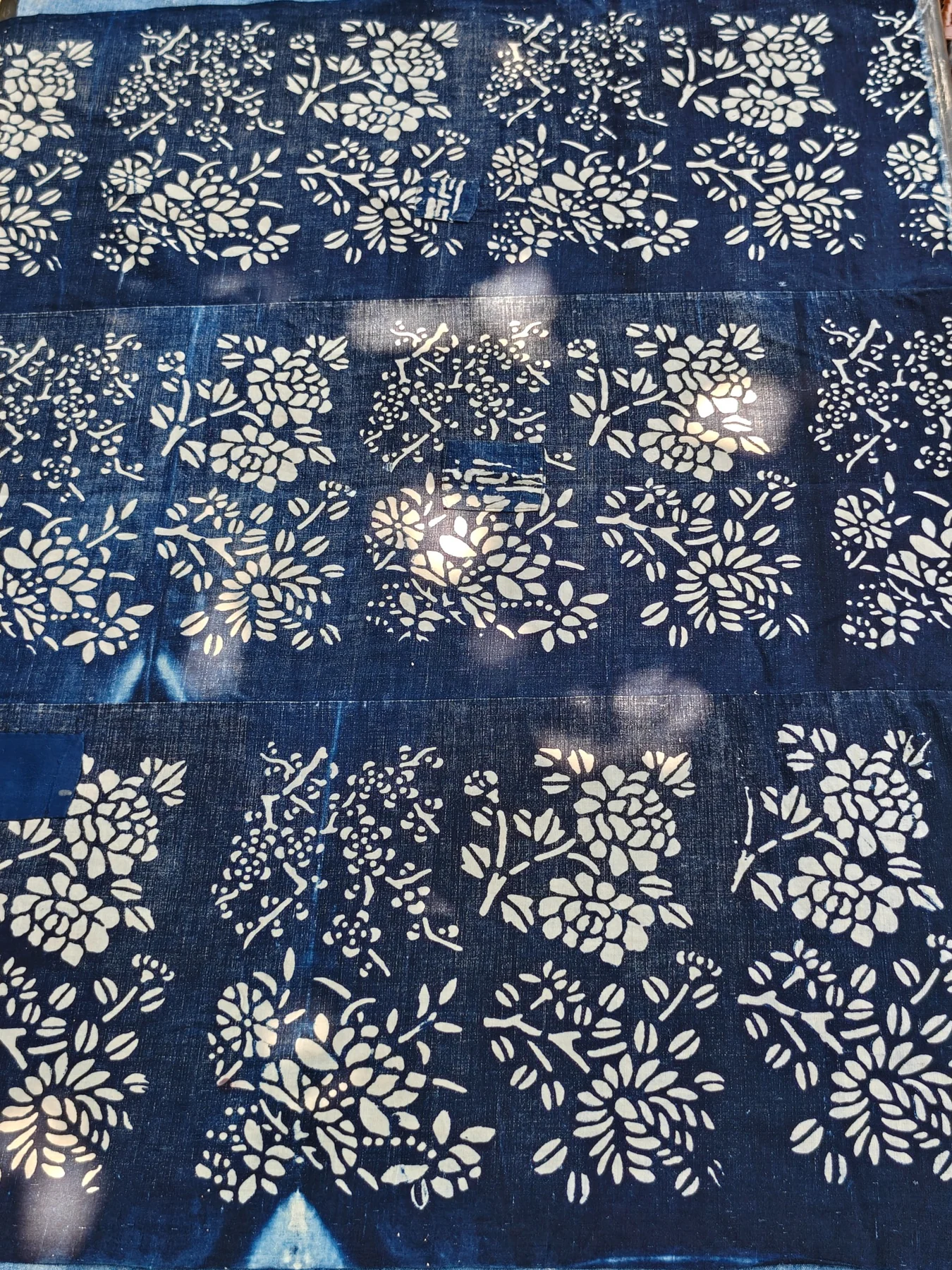
Traditional Nantong blue calico is based on a resist process. A pattern is protected before the cloth enters the indigo dye, leaving selected areas light while the exposed cloth becomes blue. Nantong municipal cultural documentation describes the regional craft as a sequence that includes stencil preparation, engraving, resist application, dyeing, removal of the resist, colour consolidation, washing and drying.1
The visual logic can be simplified as:
light cotton ground → resist pattern → indigo dyeing → resist removed → blue-and-white design
The important point is that the white pattern is not created by weaving white motifs into a blue ground.
It is produced through the relationship between resist and dye.
This makes blue calico structurally different from a yarn-dyed check, a figured weave or a picked pattern, even when the finished textiles may share similar flowers or geometric forms.
Three Indigo Layouts
Four Seasons Flowers — Nantong Indigo Quilt Cover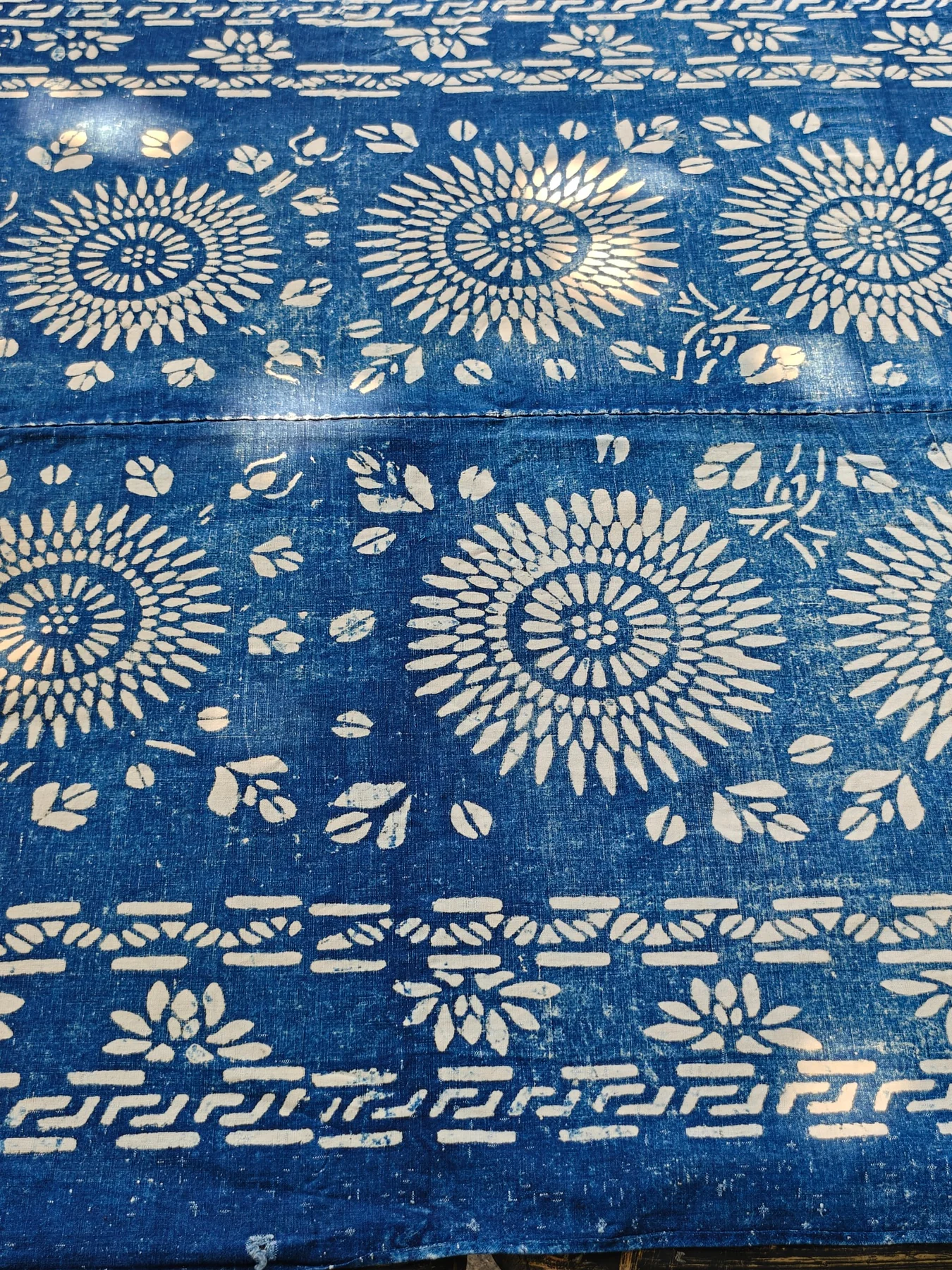 Chrysanthemum Medallions — Nantong Indigo Textile
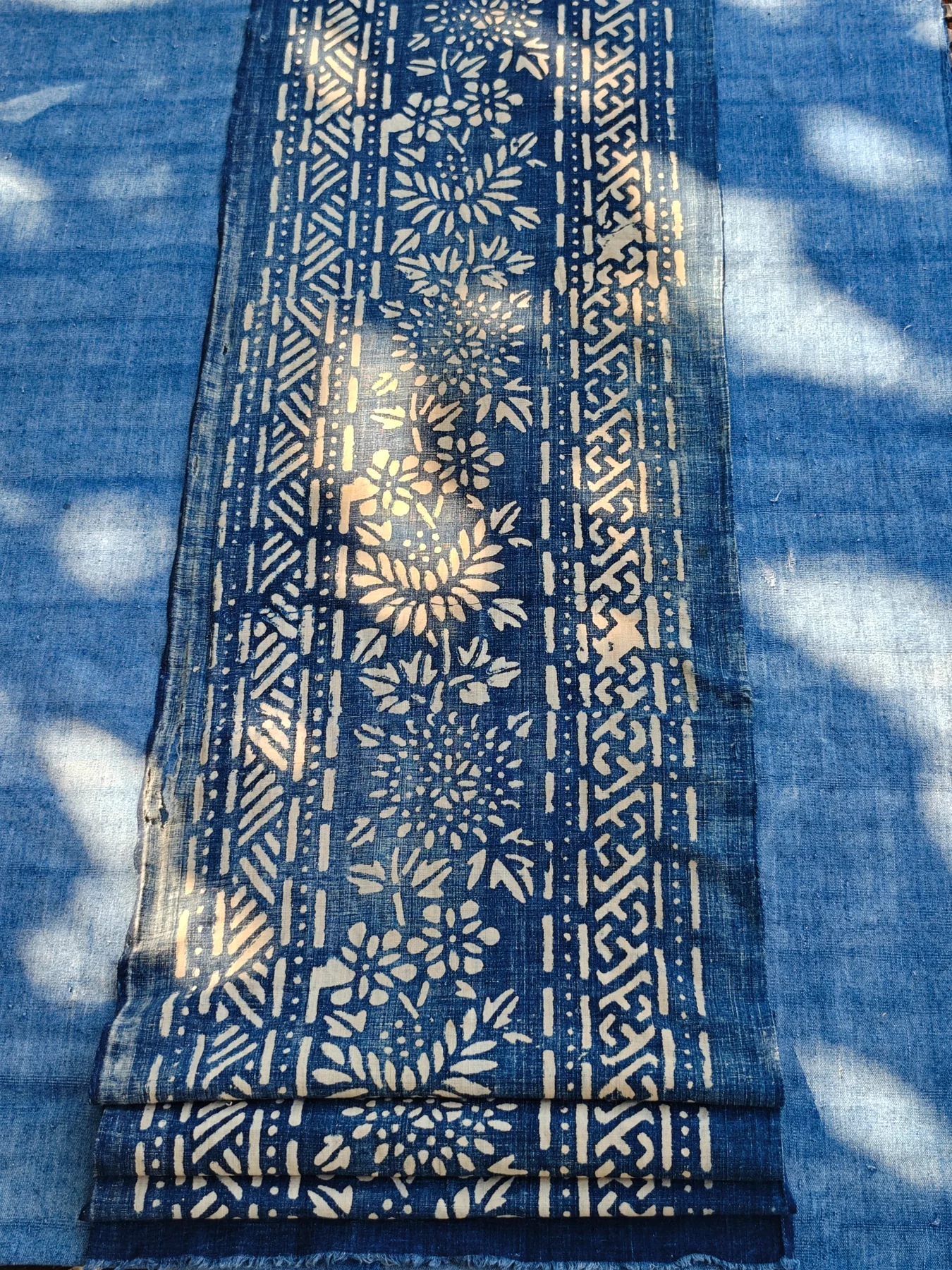 Chrysanthemum Border — Nantong Indigo Panel
How the Resist Pattern Was Made
Traditional Nantong blue calico used carved stencils and resist paste before indigo dyeing.
Official Nantong cultural documentation describes preparation and carving of the stencil, application of resist paste, dyeing, removal of the resist, washing and drying.1 Local historical documentation for the Erjia tradition also records resist mixtures using lime and soybean flour and durable paper stencils prepared for repeated use.2
A simplified sequence is:
- Stencil
- Resist Paste
- Indigo Vat
- Oxidation
- Remove Resist
- Wash
The stencil is crucial. Its openings determine where resist reaches the cloth. Protected areas remain comparatively light while the uncovered surface takes up the dye.
The result is surface pattern added after weaving.
Pattern Was Added After Weaving
This is one of the easiest distinctions to miss when looking at an old textile.
Two blue-and-white cloths may appear related at first glance.
In one, the pattern may be woven into the structure through coloured warp and weft.
In another, a comparatively simple woven ground may carry a resist-printed surface.
The difference is fundamental.
A woven pattern is created by the organisation of yarns.
A printed pattern is applied to an already woven ground.
This is why Tubu Atlas records weave and surface technique separately.
Flowers, Animals and Figural Pattern
Nantong blue calico is often associated with floral and geometric designs, but surviving pattern vocabularies can be broader.
Flowers, birds, animals, vessels and human figures can all appear within printed compositions.
For Tubu Atlas, however, the visual identification of a motif and the interpretation of its meaning remain separate questions.
A dragon and phoenix can be identified visually. A child and vase can be identified visually. A specific historical meaning should only be assigned where the evidence supports it.
Blue Calico as Household Cloth
Blue calico was not made only as decorative art.
Nantong municipal documentation records practical uses including bedding, sheets, package coverings, pillow textiles, door curtains and other household applications.1
This matters when looking at surviving pieces. A large patterned field may originally have formed part of bedding. A narrow fragment may preserve only part of a much larger composition. Wear, seams, repairs and fading can help explain how the cloth lived before it became a collectible textile.
A printed textile is both a pattern and an object that was used.
From Blue-and-White to Colour Printing
Nantong’s printed-cloth history did not stop with an indigo-and-white palette.
Twentieth-century production structures and printing technologies changed.
Local historical documentation from Erjia records that after dye workshops were consolidated into a printing and dyeing factory in 1954, production expanded beyond conventional blue calico to include double-sided printing, compound printing and colour printing.2
This should not be read to mean that every later colour-printed cotton from Nantong came from Erjia, or that all colour prints developed directly from traditional blue-calico workshops.
Instead, it gives us a useful historical marker:
the regional world of printed cotton continued to evolve.
For the archive, later colour prints therefore deserve to be documented on their own terms. They may share a regional cotton history with older blue-and-white textiles while belonging to a different production context.
From Indigo Restraint to Multicolour Print
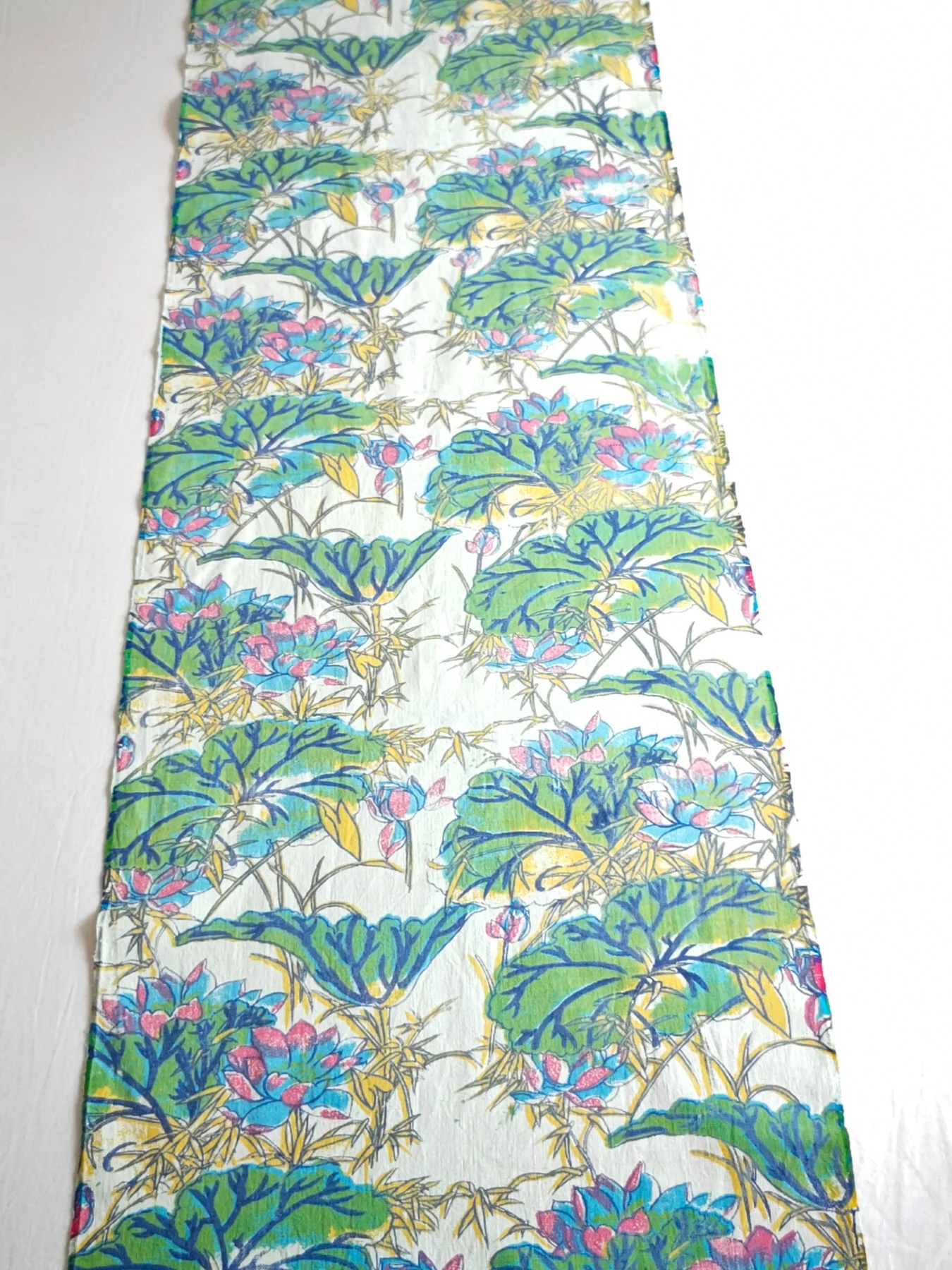 Old Pond Lotus — Nantong Printed Homespun Cotton
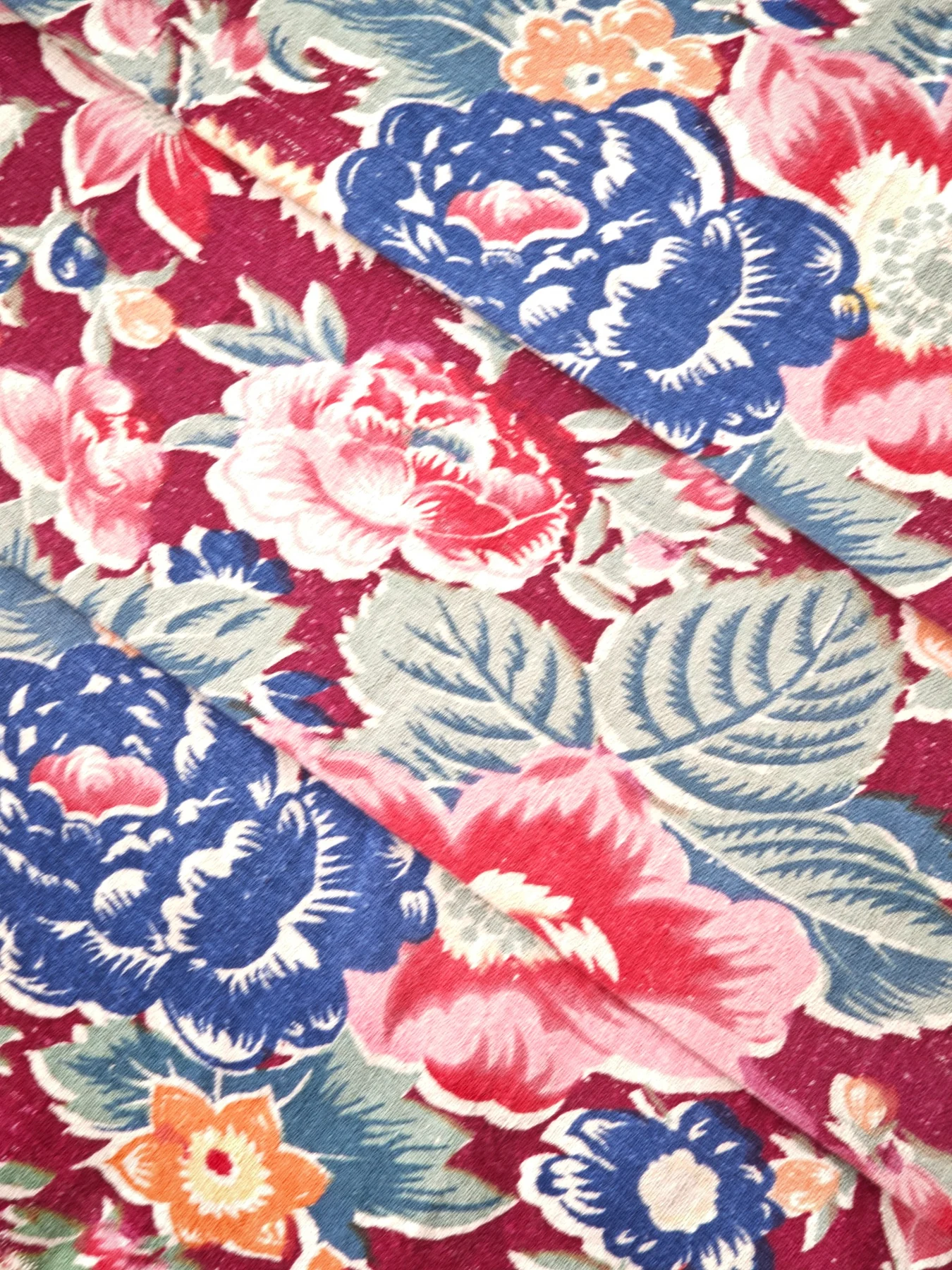 Crimson Peony Garden — Nantong Hand-Printed Homespun
Not Every Nantong Print Is “Blue Calico”
This distinction deserves to be stated directly.
A textile should not be called lanyin huabu simply because:
- it comes from Nantong;
- it contains blue;
- it is old;
- or it has a repeating floral pattern.
Blue calico refers to a particular resist-printing and indigo-dyeing tradition.
A later multicolour printed cotton can belong to Nantong textile history without belonging to exactly the same technique.
This distinction is central to Tubu Atlas.
The archive groups objects by evidence rather than visual resemblance alone.
Woven Pattern Is Not Printed Pattern
A similar geometric rhythm can come from a completely different making process.
Printed surface
Chrysanthemum Border — Nantong Indigo Panel
Blue resist printing / Lan Yin Hua Bu (蓝印花布) · Traditional narrow-width household cloth
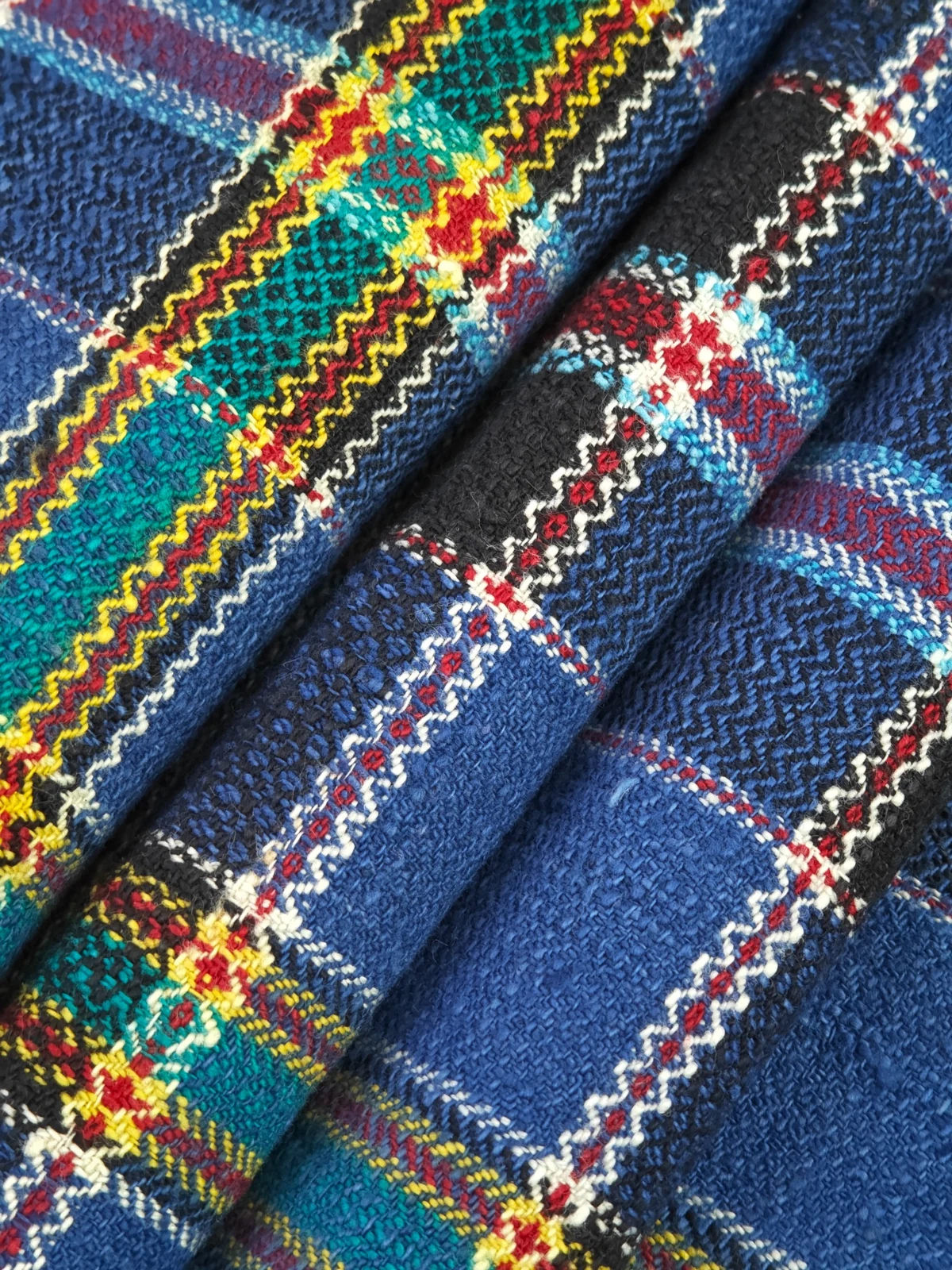
Woven structure
Blue Dragon Lattice — Nantong Treadle-Woven Homespun
Handwoven homespun · Treadle / figured weave · Yarn-dyed weave
How to Read a Printed Textile
When examining a surviving Nantong print, Tubu Atlas looks at several kinds of evidence separately.
Ground Cloth
What is the weave? How wide is the cloth? What does the yarn suggest? Is the cloth handwoven, machine-woven or uncertain?
Surface Technique
Does the pattern appear resist-dyed, surface-printed, hand-printed or produced through another process? If the method cannot be securely identified, record that uncertainty.
Colour
Is the palette indigo and light ground? Are several colours present? Do colours overlap or register in separate layers?
Repeat
How large is the pattern unit? Is the composition all-over, bordered, medallion-based or panelled?
Use
Are there seams, repairs, worn areas, cut edges or other clues to a former household function?
Provenance
Is Nantong documented, inferred from textile characteristics, or inherited from an earlier seller or collector attribution?
These are different levels of evidence. Confidence in one does not automatically prove the others.
Printed Cloth in the Tubu Atlas
Tubu Atlas records printed cloth as both textile and process.
The cloth underneath matters.
The surface treatment matters.
So do motif, colour, repeat, wear, provenance and attribution confidence.
Placing an indigo-resist household textile beside a later multicolour floral cotton does not mean they were made in the same way.
Their value lies partly in the differences between them.
Together, individual records can begin to show how a regional cotton-textile culture changed over time—from woven ground cloth and dye workshops to resist printing, later printing technologies and new colour systems.
The archive does not require every object to fit one fixed definition of “Nantong print.”
What does this particular piece allow us to say?
At publication, the Atlas contains 14 Nantong records catalogued with one or more printing-related technique fields. That count reflects the current collection, not a complete survey of Nantong textile production.
Frequently Asked Questions
Is Nantong printed cloth the same as blue calico?
No. Blue calico is one important Nantong printed-textile tradition based on resist and indigo dyeing. Nantong’s wider printed-cloth history also includes later textiles using other colours and processes.
Is the white pattern in traditional blue calico printed with white pigment?
In traditional resist-printed blue calico, the light areas are created by protecting selected parts of the cloth from the indigo dye rather than simply printing white pigment over a blue ground.
Was blue calico woven with the pattern already in the cloth?
No. In traditional resist-printed blue calico, the ground cloth is woven first and the surface pattern is created afterward through resist and dyeing.
Was all Nantong printed cloth handmade?
No. Traditional blue-calico production is associated with hand processes, but twentieth-century printing and dyeing technologies changed. Surviving objects should therefore be identified individually rather than assumed to share one production method.
Is every old blue-and-white cotton from Nantong?
No. Indigo resist traditions existed beyond Nantong. Colour and motif alone are not sufficient evidence for geographic origin.
Sources & Further Reading
- Nantong Municipal Government. “Nantong blue calico printing and dyeing craft.” Used for regional craft context, process stages and documented household applications.
- 南通史志网:《二甲蓝印花布》. Used for the Erjia tradition, lime-and-soybean-flour resist, stencil preparation, the 1954 workshop consolidation and later double-sided, compound and colour printing.
- 南通史志网:《蓝印花布》. Used for local indigo, dye-workshop and regional blue-calico context.
- 《江南土布史》. Broader background for cotton production, household weaving and changing textile markets in Jiangnan.
- 林举百,《近代南通土布史》. Broader context for Nantong cotton production, weaving, merchants and markets.
- 《中国传统土织布手工技艺与复原》. Used for distinctions between woven structures and surface pattern and for regional textile comparison.