
Tiaohua (挑花) is a deceptively simple Chinese term.
Across different regions and textile traditions, the same two characters can refer to very different ways of making pattern. In Huangmei and Huayao traditions, official English descriptions use terms such as Tiaohua (Cross-Stitch Work) or Tiaohua cross-stitch embroidery: the ground cloth already exists, and a needle and coloured thread are used to build pattern across it.1
The Jiangnan textile discussed here belongs to a different making logic. Its motifs are formed while the cloth itself is being woven.
For this loom-based practice, Tubu Atlas uses an editorial disambiguation:
Loom Tiaohua (织机挑花)
Hand Pick-Up Weaving
The Chinese term preserves the local textile vocabulary. The English phrase describes the manual pattern-forming action and keeps this loom process distinct from post-weaving embroidery.
Pattern Made While the Cloth Is Woven
The simplest distinction is one of timing.
In the loom-based process documented here, a ground structure is established on the loom. At selected moments during weaving, particular groups of warp threads are manually selected or lifted so that a patterned shed can be formed and the weft inserted.
A simplified working sequence can be understood as:
- 01Ground weave
- 02Select warp threads
- 03Lift selected threads
- 04Insert weft
- 05Beat into place
- 06Repeat
The exact thread structure and loom arrangement can vary. An old textile does not always preserve enough evidence to reconstruct every movement made by its original weaver. Tubu Atlas therefore uses Hand Pick-Up Weaving as an explanatory technical term for the manual pattern-forming principle rather than claiming one universal loom setup for every regional example.
The essential point is structural:
the motif belongs to the woven cloth itself.
Hai Shang Ji Hua — Shepherd’s Purse Flower
The clearest current anchor object in the Tubu Atlas is Hai Shang Ji Hua — Shanghai Shepherd’s Purse Picked-Weave Textile.
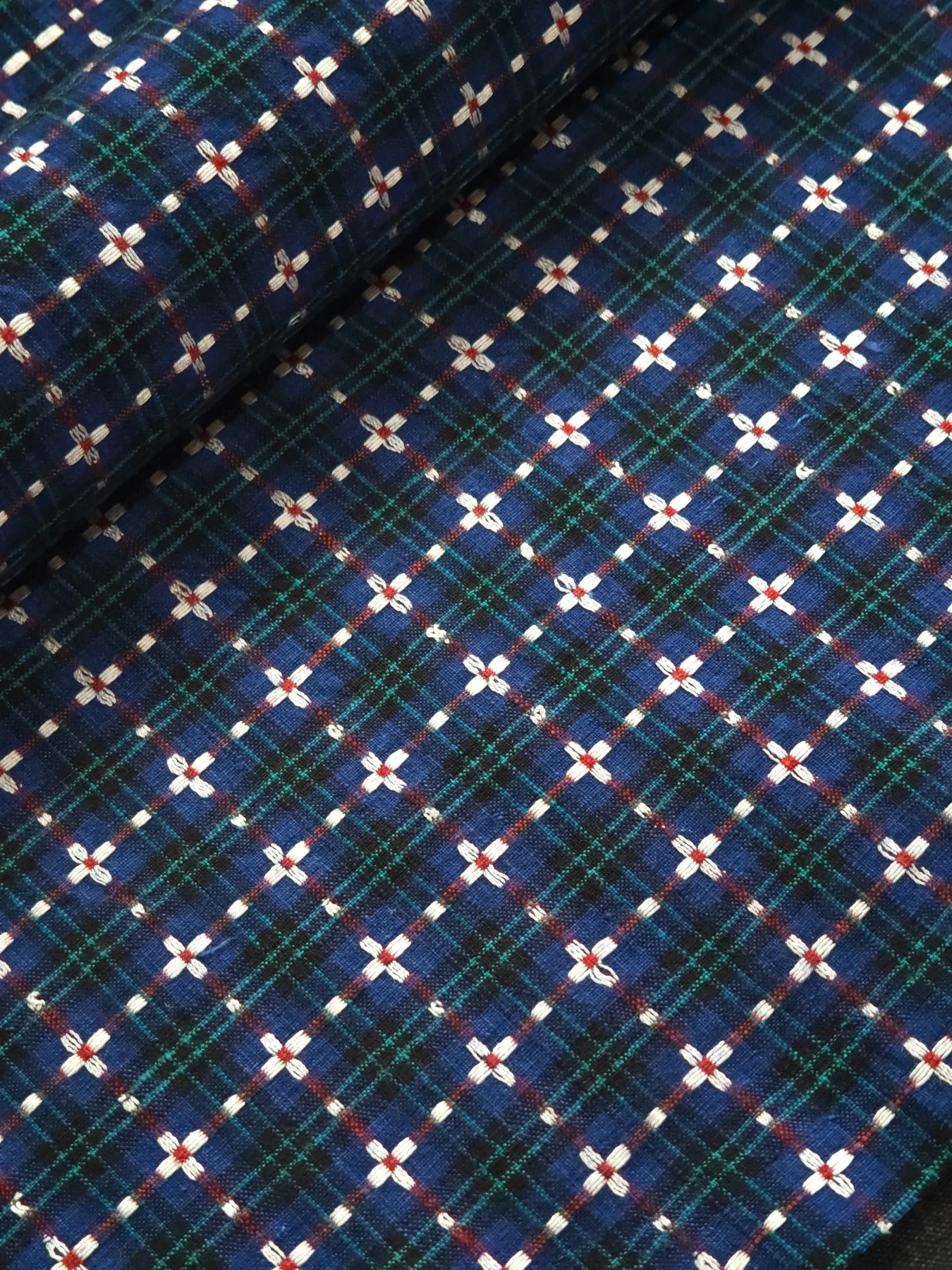
Its ground is already visually complex. Deep blue, black and green form a yarn-dyed checked field, crossed by fine red and green lines. Against this darker geometry appear repeated white four-petal flowers with small red centres.
From a distance, the white motifs can resemble embroidery. At close range, their relationship with the ground is different: the patterned elements participate in the woven cloth rather than sitting as a separate needleworked layer above an already completed ground.
This object illustrates the defining idea of loom tiaohua:
the flower does not merely decorate the cloth; it emerges through the making of the cloth.
A Grid Beneath the Flower
The flower is only one layer of the design. Before the eye notices the white blossom, the textile already has a strong system of colour and structure: indigo-blue fields, black and green checks, thin red intersections and repeating squares.
This layered construction belongs to a wider Jiangnan vocabulary in which small floral or dot-like motifs sit inside checked and striped colour-woven grounds.
Research on Jiangnan Homespun Patterns (《江南土布纹样研究》) is particularly useful here. Its chapter on natural motifs documents 梅花纹 and 海棠花纹 as small cross-shaped, four-part and dot-like floral units that can appear inside checked cells or repeat into larger continuous systems. The book is used here as evidence for motif vocabulary, not as sole proof that every visually similar textile was made with the same loom mechanism.2
Motif tells us what we see. Technique asks how it was made.
Related Picked Structures in the Atlas
Not every small woven flower or coloured dot in the collection is currently catalogued as loom tiaohua. Two related objects are deliberately kept in a neighbouring category: picked-dot weave.
The visual relationship is important, but it is not enough to collapse the categories. Until a textile’s local terminology and loom mechanism are better documented, the Atlas keeps picked-dot weave and loom tiaohua related but distinct.
Picked, Treadled, Drawn or Stitched?
Four patterned textiles can look surprisingly similar from the surface while being made in fundamentally different ways. This is the quickest way to separate the mechanisms.
Hand Pick-Up
Direct manual selection. The weaver selects warp groups during the weaving sequence, using the hand or a pick-up stick to create the patterned opening.
Loom Tiaohua / Hand Pick-Up WeavingTreadle Figuring
Pattern organised by loom setup. Heddles and treadles control repeated warp movements, allowing a planned structural pattern to be reproduced through a treadling sequence.
Hand-operated loom, but not direct pick-up for every motif unitDrawloom
Pattern control is separated from weaving. In the traditional Nanjing Yunjin great drawloom, an upper draw worker operates pattern cords while a lower weaver forms the cloth.3
Two-person figured-weaving systemTiaohua Embroidery
Pattern is added later. A finished ground cloth is counted and stitched with a needle. Official English descriptions of Huangmei and Huayao traditions use “Tiaohua (Cross-Stitch Work)” or cross-stitch embroidery.1
Counted-thread needlework on completed clothLoom Tiaohua Is Not Treadle Figuring
A woven pattern can be made entirely on a handloom without the weaver manually selecting the relevant warp groups for every motif unit.
In treadle-figured weaving, combinations of heddles and treadles organise repeated warp movements. Once the loom is set up, the weaver can reproduce the planned structure through the treadling sequence.
And Then There Is the Drawloom
Large traditional Chinese figured looms can solve the problem of complex patterning in a completely different way: by dividing the work between two people.
The best-known surviving example is the Nanjing Yunjin great drawloom (大花楼木织机). Official Chinese intangible-cultural-heritage documentation describes a large wooden drawloom operated through cooperation between a draw worker and a weaver.3
The upper worker controls the pattern-selection cords. The lower weaver operates at the cloth level, inserts the weft and beats the textile into place. Nanjing documentation describes this visible two-level arrangement in museum demonstrations: a draw worker sits above while the weaver works below.4
This is not the same mechanism as the small-scale manual pick-up described for the Shepherd’s Purse homespun. Both create pattern during weaving, but their mechanical logic is different.
“Woven in” does not describe one single technology.
When “Tiaohua” Means Embroidery
The ambiguity of the Chinese word is worth preserving rather than hiding.
In Huangmei and Huayao traditions, tiaohua refers to needle-based counted-thread work on an already woven ground. In this Story, loom tiaohua is a Tubu Atlas disambiguation for the loom-based pick-up tradition documented in the Jiangnan object group.
Both uses of 挑花 can be culturally legitimate. They are simply different textile processes.
How to Read a Possible Hand Pick-Up Textile
No single clue proves that an old cloth is loom tiaohua. Tubu Atlas looks at several kinds of evidence together.
Follow the motif yarn
Does the decorative yarn participate in the woven structure? Can its path be followed into and through the cloth?
Examine the reverse
How do the patterned threads behave on the back? A woven structure and post-weaving needlework often leave very different yarn paths.
Identify the ground first
Plain weave, stripe, check or yarn-dyed ground should be understood before the additional motif is interpreted.
Look for repetition and variation
Small shifts can support a manual-production reading, but irregularity alone is never proof of hand pick-up.
Separate motif from technique
“Plum blossom,” “shepherd’s purse” or “begonia” names what the pattern resembles; it does not identify the loom mechanism.
Keep uncertainty visible
If the loom setup cannot be reconstructed from the surviving cloth, the record should say so rather than turning visual similarity into certainty.
Why Loom Tiaohua Matters
Loom tiaohua occupies a fascinating middle ground. A relatively modest household loom can carry pattern that requires knowledge beyond ordinary plain weaving.
The maker must understand the ground structure, the position of the relevant warp threads, the sequence of intervention and the rhythm through which each picked unit repeats across the cloth.
A four-petal flower may be small, but repeating it across metres of cloth transforms counting, memory and hand movement into a durable visual system.
That labour becomes almost invisible once the textile leaves the loom.
The surviving cloth gives it form again.
Loom Tiaohua in the Tubu Atlas
Tubu Atlas uses Loom Tiaohua / Hand Pick-Up Weaving conservatively. It is not a catch-all label for every woven decorative pattern.
The strongest current anchor is Hai Shang Ji Hua. Related picked-dot structures such as Four Seasons Dot Grid and Little Plum Blossom remain separately catalogued, while treadle-figured objects such as Blue Dragon Lattice stay in their own structural category.
The terminology can evolve if stronger loom, practitioner or historical evidence becomes available.
Where the making process is documented, we name it. Where the relationship is visual but the mechanism remains uncertain, we preserve the uncertainty.
Frequently Asked Questions
Is tiaohua the same as cross-stitch embroidery?
Not always. Official English descriptions of Huangmei and Huayao traditions use cross-stitch work or cross-stitch embroidery for needle-based tiaohua. In this Story, loom tiaohua refers specifically to pattern formed during weaving through manual pick-up.
Why does Tubu Atlas use “Hand Pick-Up Weaving”?
It is an explanatory English label for the observed manual pick-up principle. Tubu Atlas retains loom tiaohua as the cultural term and does not present this translation as a universal historical English name.
Is loom tiaohua embroidery?
No. In loom tiaohua, the motif is formed during weaving rather than stitched onto a completed cloth afterward.
Is loom tiaohua the same as treadle-figured weaving?
No. Both create pattern within the woven structure, but they organise warp selection differently.
Is a drawloom a type of loom tiaohua?
Not in the terminology used by Tubu Atlas. A drawloom is treated as a separate figured-weaving system with a distinct pattern-control mechanism; the traditional Nanjing Yunjin great drawloom is famously worked by an upper draw worker and a lower weaver.
Does a four-petal flower prove that a textile is hand pick-up woven?
No. Similar motifs can be made through different technologies. Pattern identification and technique identification must remain separate.
Sources & Further Reading
- Hubei Provincial People’s Government. “Tiaohua (Cross-Stitch Work).” Used to distinguish needle-based tiaohua traditions from loom-based patterning.
- 张岚、宋益萍,《江南土布纹样研究》. 中国纺织出版社有限公司, 2024.8, ISBN 978-7-5229-1821-1. Used for Jiangnan motif vocabulary, especially the small four-part 梅花纹 and 海棠花纹 families. The book is used here for motif comparison, not as sole evidence for loom mechanism.
- 中国非物质文化遗产网. Nanjing Yunjin wooden drawloom weaving documentation. Used for the two-person drawloom comparison.
- Nanjing Municipal People’s Congress. Documentation of the Yunjin Museum drawloom demonstration. Used for the upper draw worker / lower weaver arrangement.
- 《中国传统土织布手工技艺与复原》. Used as broader reference for Chinese homespun construction, handweaving and regional textile comparison.