
What if a basket of fruit could hold a family's hopes for the future?
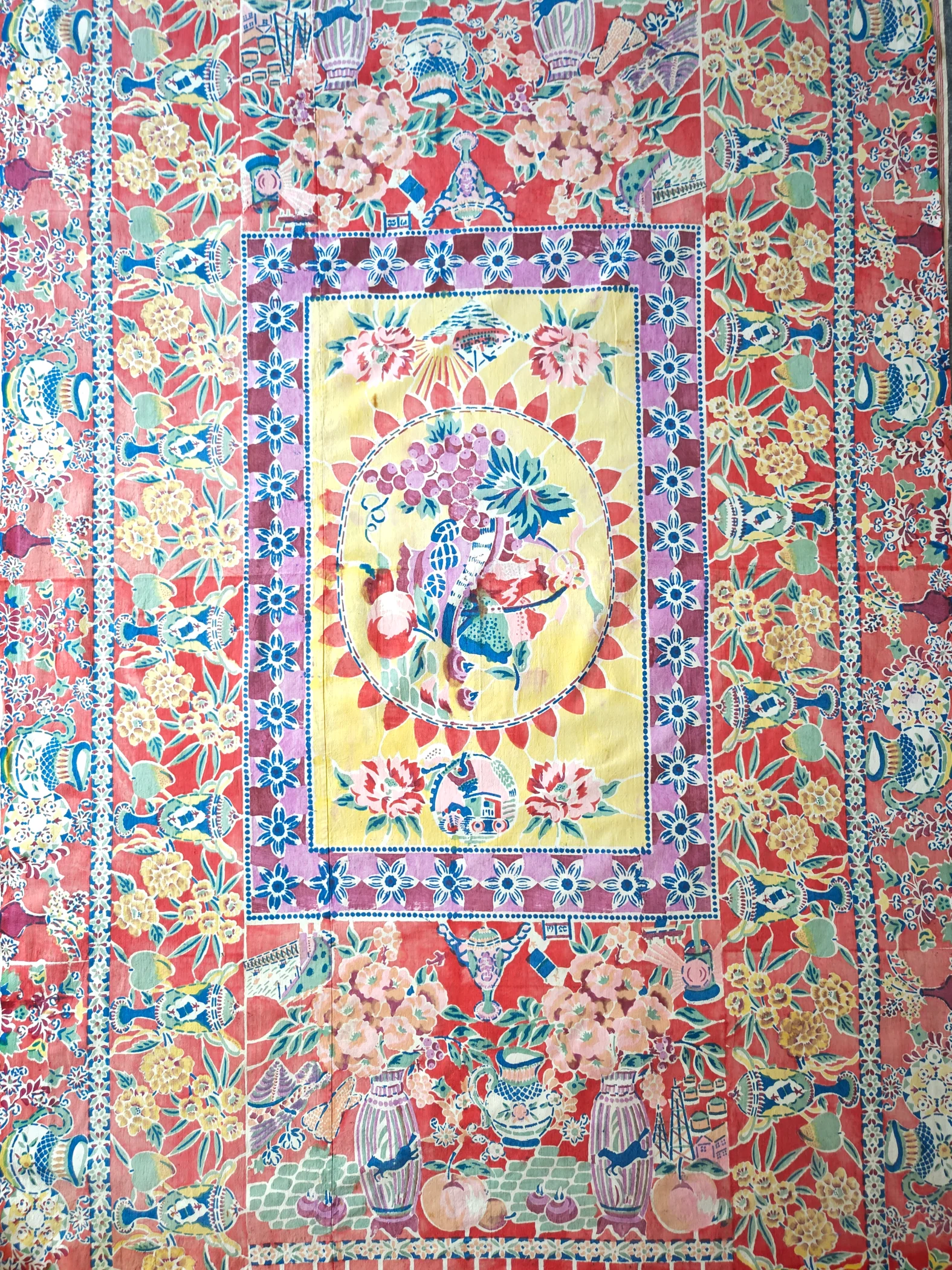
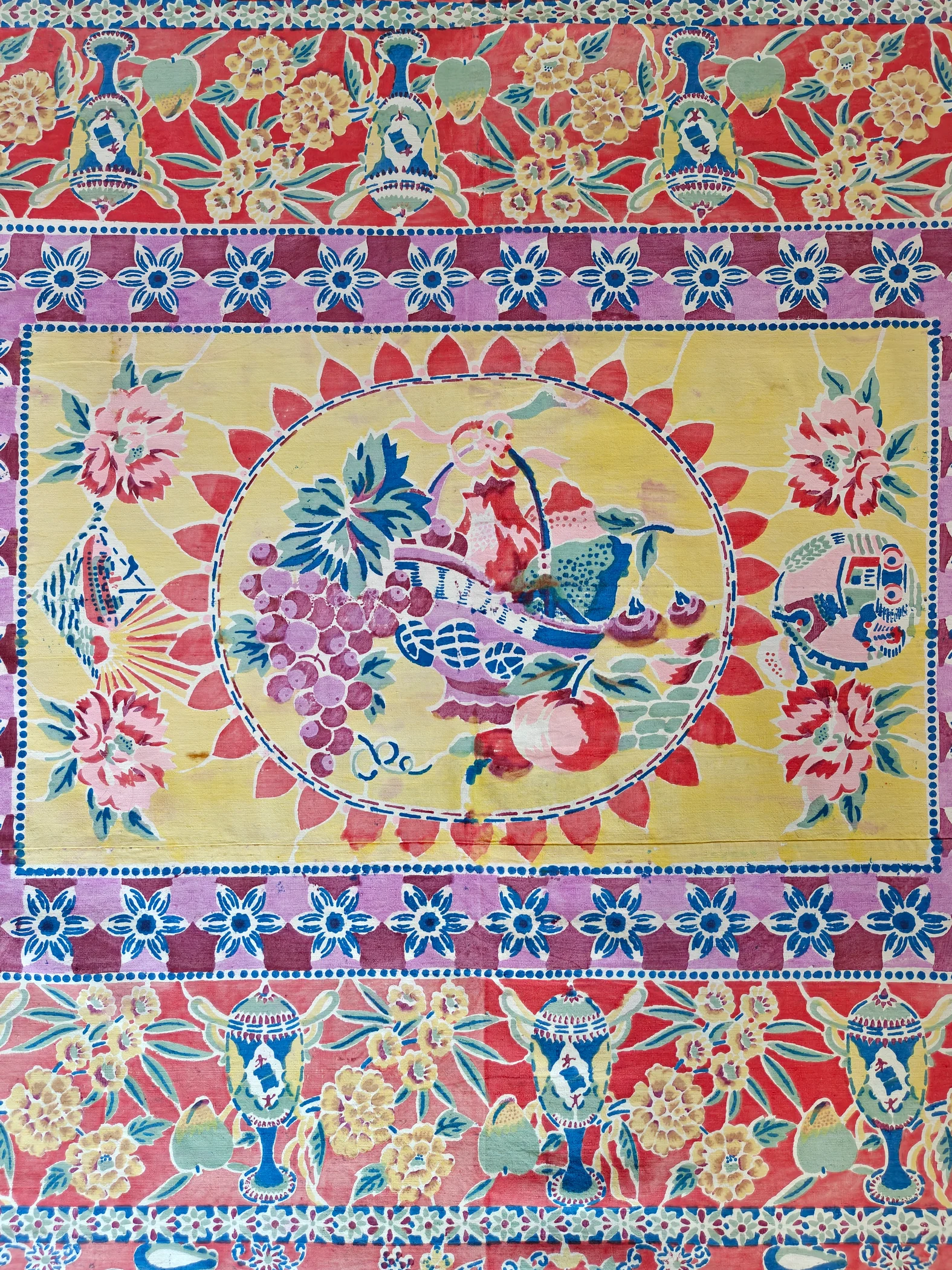
On a brightly printed Chinese household textile, grapes tumble from a fruit basket. Peach-like fruits rest below, while vessels, peonies and blue floral borders surround the scene.
These are not merely cheerful decorations. They belong to a much older language of wishes — for good fortune, a long life and a family that flourishes.
Explore the original Tubu Atlas textile →Three blessings, often expressed without writing a single word.
What Does San Duo Mean?
San Duo (三多) literally means “three abundances”. In traditional Chinese auspicious art it brings together three wishes: 多福 (many blessings), 多寿 (long life) and 多子 (many descendants).
Rather than spelling out these hopes, artists could represent them through fruit. The symbolism was especially suitable for objects kept close to household life — a curtain, a pillow covering or a bed textile.
The textile study 《南通蓝印花布》 (Nantong Blue Printed Cloth) documents a conventional arrangement of Buddha's hand citron (佛手), pomegranate (石榴) and longevity peach (寿桃). The book illustrates the motif on both a door curtain and a pillow cloth (Chapter 5, section on auspicious fruit patterns, pp. 169–170).
Buddha's hand citron
Many blessingsIts finger-like citrus segments give it a remarkable silhouette. Its name and long-standing auspicious associations make the Buddha's hand a sign of good fortune in traditional decorative art.
The longevity peach
A long lifePeaches evoke long life and health, drawing on stories of the peaches of immortality. On everyday cloth, the wish becomes intimate: many more years with those we love.
The pomegranate
Many descendantsThe numerous seeds inside a pomegranate inspired images of family continuity. In traditional marriage and household decoration, an opened pomegranate became a familiar blessing for descendants.
These three forms describe the documented traditional formula. The particular fruit basket in the Tubu Atlas textile below uses a different combination of stylised fruit.
The Tradition Is Recognisable. The Details Can Change.
There is no need to force every Chinese folk fruit basket into the same inventory of objects. The three-fruit formula documented in the book is a specific pattern convention; individual printers could also arrange other fruits that carried related auspicious associations.
Grapes, for instance, form generous clusters with many individual fruits. They could suggest abundance and flourishing descendants within a broader repertoire of Chinese decorative art. Their presence does not make grapes one of the three fruits specifically named in the book's historical San Duo example.
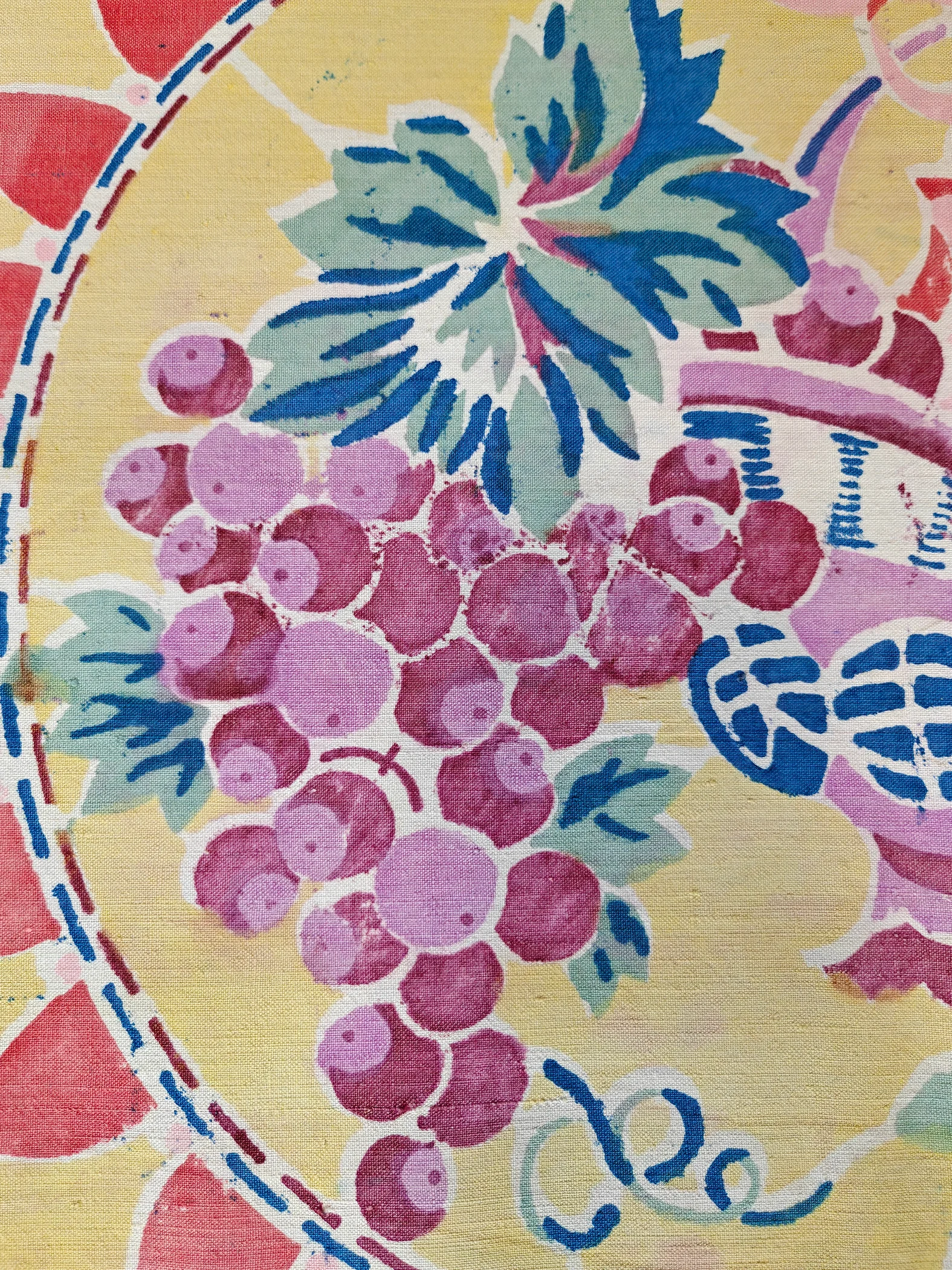
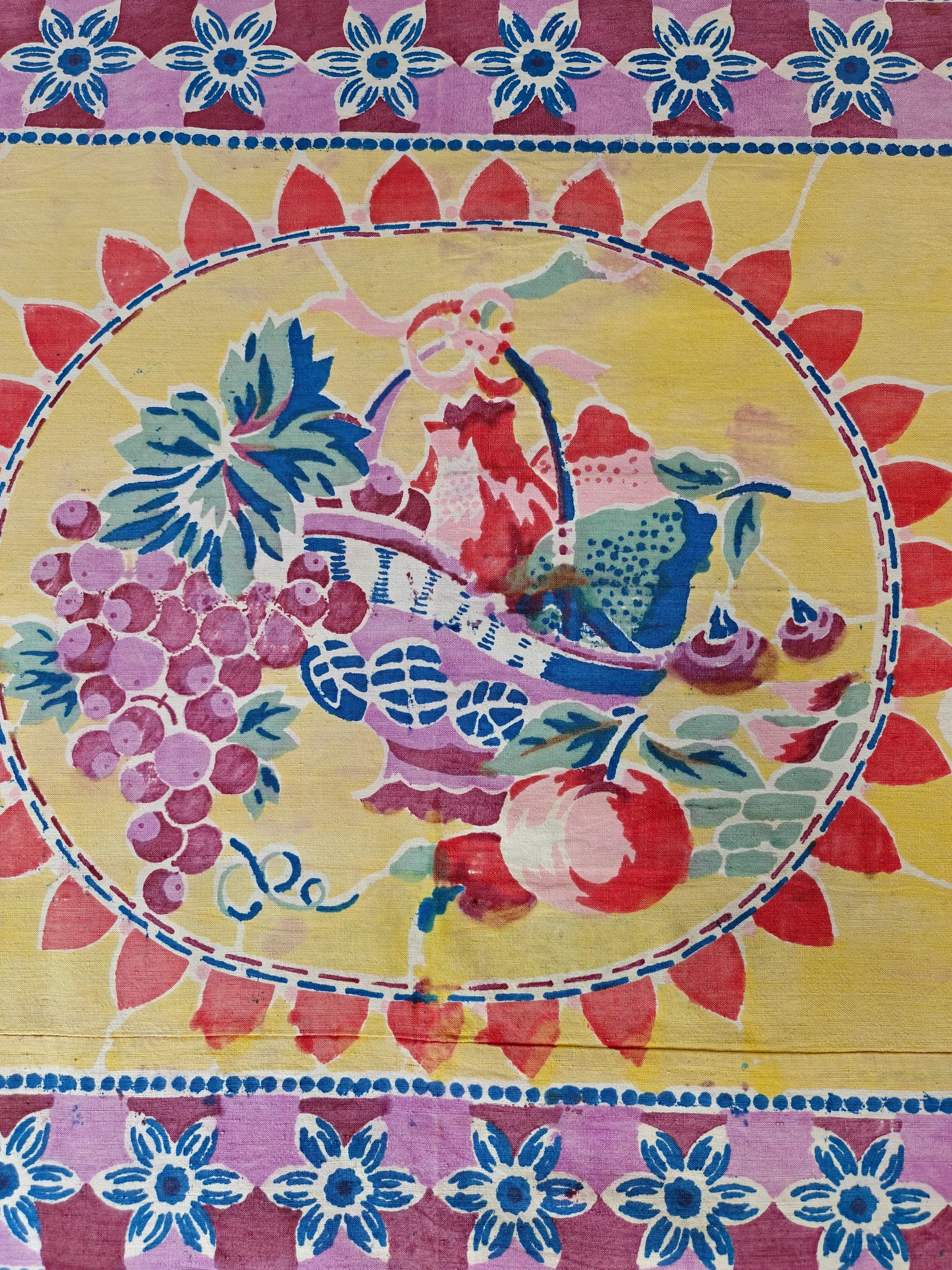
This difference is part of what makes folk textiles compelling: a recognisable blessing could live on through variations of shape, colour, scale and arrangement.
Three Blessings Treasure Basket
Our featured textile is not a blue-and-white resist-dyed cloth. It is a richly coloured folk-printed cotton, with a warm red ground, a yellow centre, pink flower heads, blue borders and patterned vessels. Its printing method is attributed to multicolour folk printing, but the exact historic blocks or screens have not been independently identified.
Within the central oval sits a basket-like arrangement of fruit. Purple grapes are the clearest detail; a large peach-like form and additional stylised fruits complete the composition. In the object's supplied inventory, the group is interpreted through the blessings associated with grapes, peaches and pomegranates. The precise identity of every small fruit remains an interpretation, not a botanical certainty.
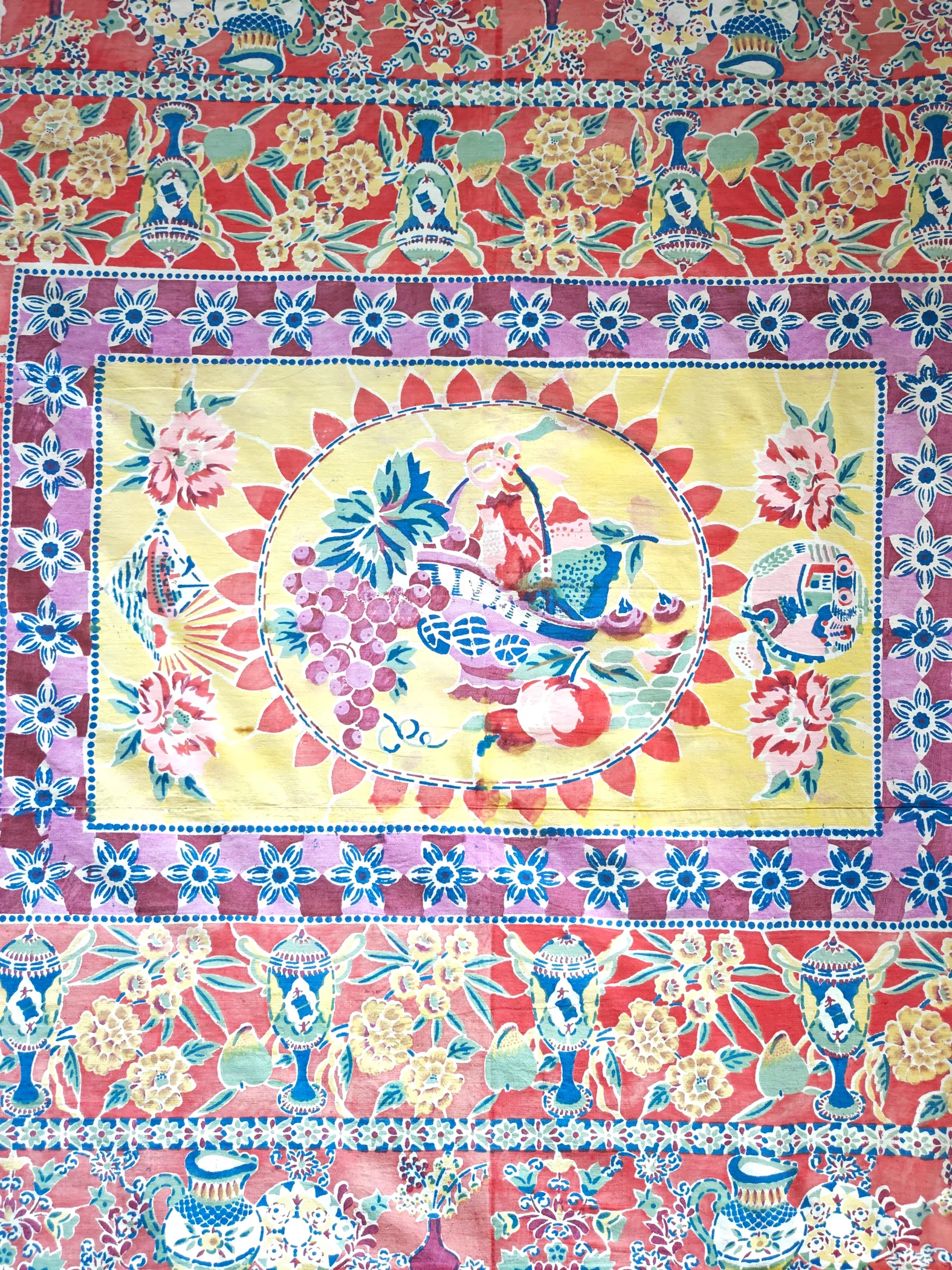
The Blessings Around the Basket
Peonies · 牡丹
Rich, layered blossoms evoke prosperity and flourishing life — one of the most familiar associations of the peony in Chinese decorative culture.
Explore the peony story →Vases · 花瓶
The sound of ping (瓶, vase) can echo ping (平, peace). Together with flowers, vases add another wish for stability and well-being.
Fruit basket · 果篮
At the centre, the gathered fruits present abundance as something shared — the household's hopes assembled within one festive image.
A Wish Kept Close to Home
In the historical examples discussed in Nantong Blue Printed Cloth, the Three Abundances appear on ordinary household objects, including a door curtain and a pillow cloth. A blessing was not necessarily written out, framed and hung separately. It could live on something touched and seen every day.
The Tubu Atlas red bedspread tells a related domestic story. It was assembled from narrower cotton lengths into a larger cloth, with visible joined seams. The stitching is part of its construction and history. The exact original household, printer and making date are unknown, and the mid-twentieth-century Nantong attribution remains estimated.
Such details matter as much as the fruit symbols. A worn edge or hand-joined seam reminds us that these objects belonged to life before they entered a collection.
Three Fruits. Three Wishes. A Life of Possibility.
A peach becomes a wish for time. A pomegranate becomes a hope for family continuity. Buddha's hand adds an invitation to good fortune.
Elsewhere, grapes and other fruits join the language of abundance in their own arrangements. The iconography changes, but the human impulse behind it is immediately recognisable: to wish someone a good life.
Sometimes the most heartfelt wishes are not written in words. They are printed into cloth.
Three Blessings Treasure Basket — Nantong Folk-Printed Bedspread
Approx. 129 × 215 cm. A large, multicolour, hand-joined cotton bedspread attributed to Nantong, with a central basket of auspicious fruit and layered floral borders.
View the original textile and its condition record →Sources & Research Notes
- Wu Lingshu, Ni Shenjian and Wu Yuanxin, 《南通蓝印花布》 (Nantong Blue Printed Cloth), Chapter 5, “Pattern Art”, the section on auspicious fruit motifs, pp. 169–170. Page 169 describes the Buddha's hand, pomegranate and longevity peach as the traditional Three Abundances, and illustrates a door curtain and pillow cloth; page 170 discusses the many-seeded pomegranate as a wish for descendants.
- Tubu Atlas textile TA-NT-0029. Owner-supplied original photos and inventory notes on dimensions, composition, fabric condition and attributed provenance.
The book is cited for historical interpretation, not reproduced here as a scanned illustration. All textile photographs in this article show the original object in the Tubu Atlas collection. The meaning of some small fruit forms, the printing equipment and exact making date have not been independently verified.