
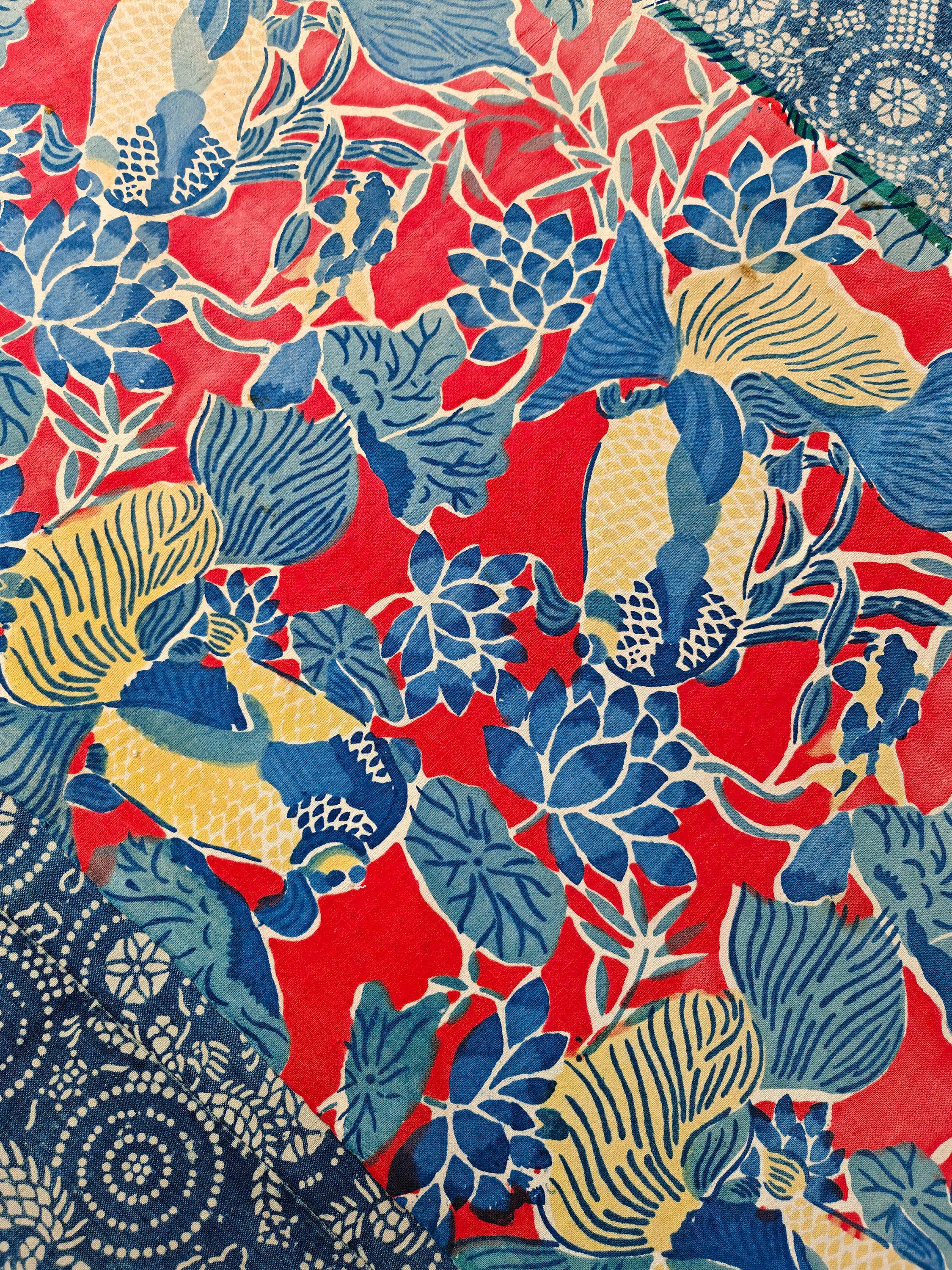
A fish turns through a garden of blue leaves. Its warm yellow body is picked out with small marks, while long fins open into the red ground. Elsewhere, another tail curves between flowers and stems. Follow the outlines and the whole cloth seems to move.
We call this piece Lotus Fortune · 莲余. Its combination of goldfish and lotus belongs to a wider language of Chinese auspicious decoration: familiar forms arranged to express hopes for a prosperous, continuing life. Looking closely reveals both the traditional wish and the individual decisions that make this particular cloth worth keeping.
How fish and lotus become a wish
In Chinese, the word for fish, yú (鱼), sounds the same as yú (余), meaning surplus or abundance. Lotus, lián (莲), echoes lián (连), meaning continuity. Together, the forms can evoke lián nián yǒu yú (连年有余): a wish for abundance year after year.
The Hong Kong Palace Museum describes fish-and-lotus imagery as expressing continual prosperity. Its explanation also connects fish and the many seeds in lotus pods with fertility and vitality. The motif can therefore carry several related wishes, from sufficient resources to the flourishing of a household.[1]
These associations give the scene a second life. The fish still swim and the lotus still supplies its broad leaves and flowers; the same forms also offer a blessing to the people living with the object.
A goldfish example in the reference library
Our research copy of Nantong Blue Printed Cloth (《南通蓝印花布》) includes a section called “Goldfish Playing Among Lotus” (金鱼戏莲), on printed page 172. It illustrates the subject on a blue-and-white wrapping cloth and connects the combination with wishes for wealth and continuing abundance.[2]
This makes a useful comparison with our red-ground textile. In the book's example, the subject sits within a framed arrangement; on Lotus Fortune, fish, foliage and flowers flow through a repeating field. The shared subject gives us a way into the design, while the layouts create different experiences of looking.
Reading the colours and movement
Begin with the red spaces. They open around the blue leaves and flowing fins, giving the forms room to separate even where the print is dense. Fine ivory lines run between areas of colour, making stems, scales and petal shapes easier to follow.
Next, look at the changes in scale. Large leaves and spreading tails establish the main rhythm. Smaller flowers, buds and curling stems link those larger forms. Repeated blue lines describe the fins and leaf surfaces, while the yellow bodies offer warm points of focus.
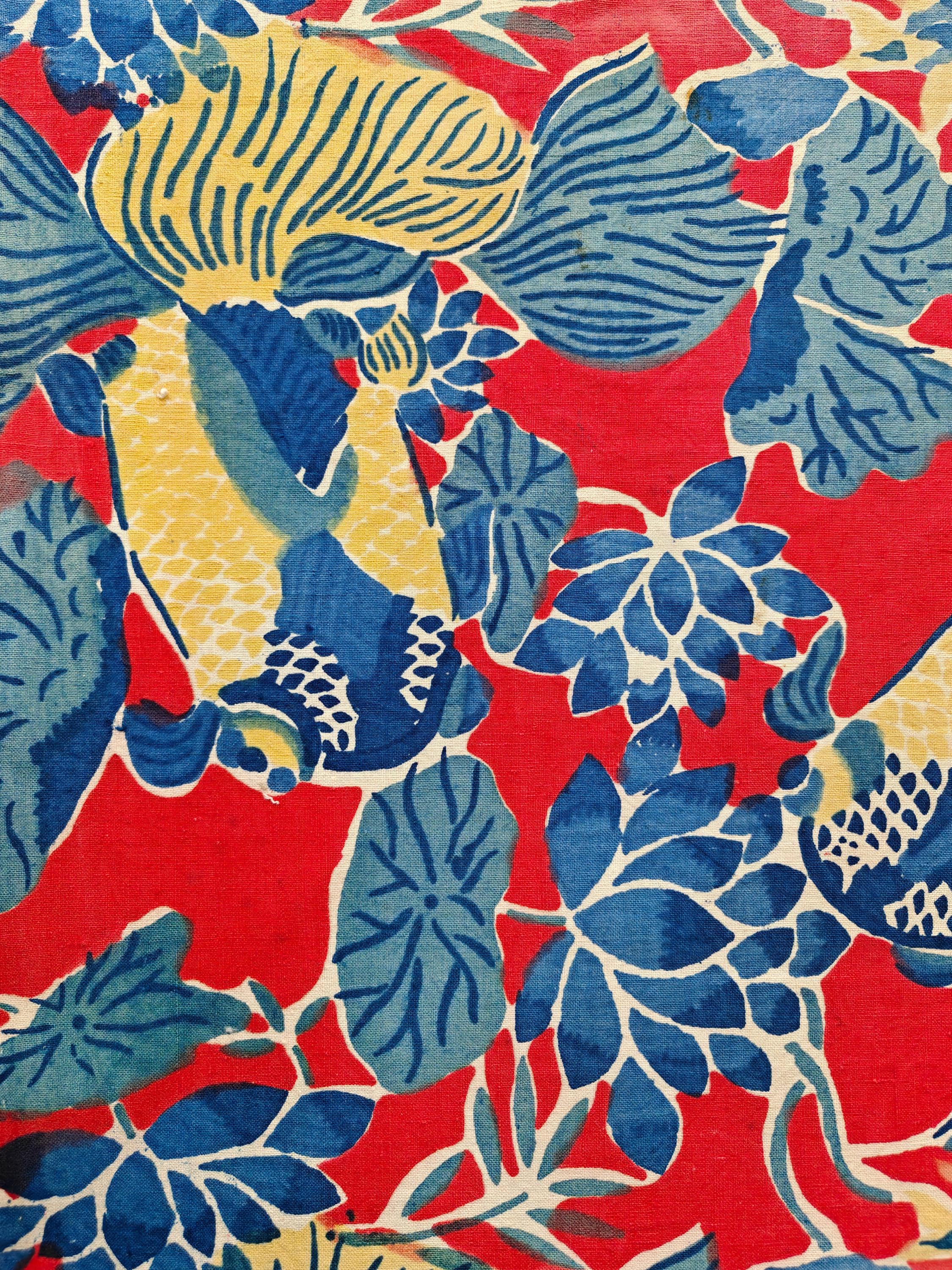
The movement comes from these relationships: broad forms beside fine marks, warm colour beside cool colour, a turning tail beside a stem that leads the eye onward. A full photograph shows their balance; a close view reveals how much drawing is held within a small area of cotton.
More fish patterns from the study collection
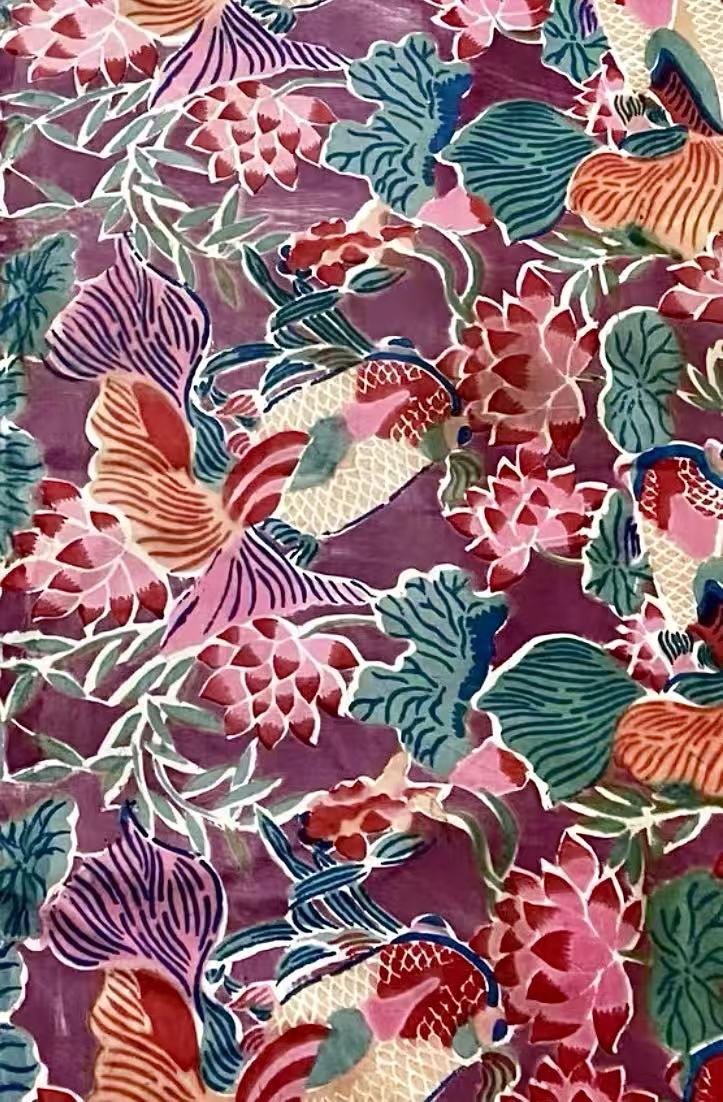
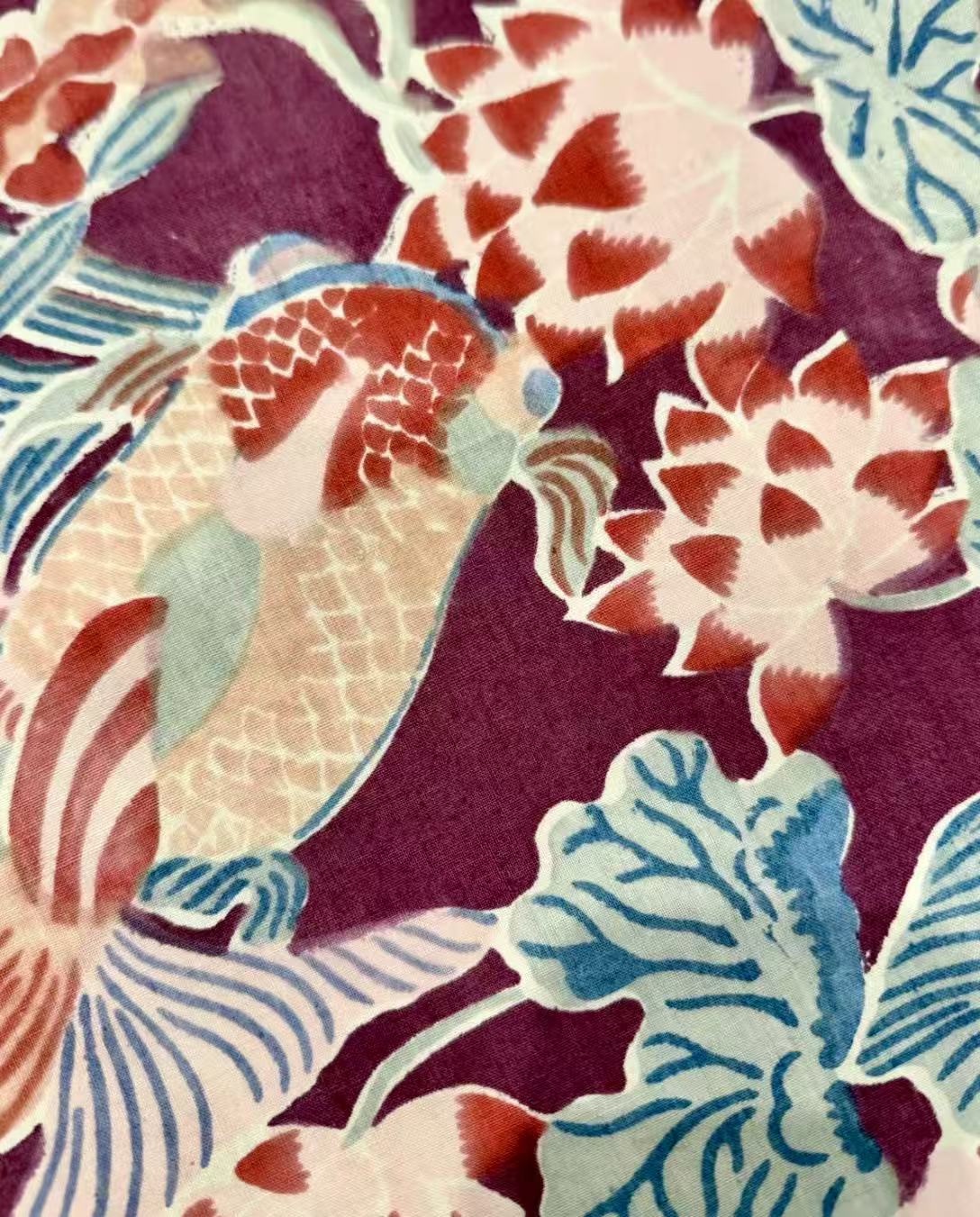
A purple-ground print gives the goldfish-and-lotus subject another palette: pink and red flowers, green leaves, pale fish bodies and spreading orange and violet tails. The wider view and close-up show the same pattern at different scales. Comparing them with Lotus Fortune brings the drawing of the scales, fins and leaves into focus.
The blue-and-white examples offer a different comparison. On the dark-ground cloth, small fish and floral forms are separated by open spaces. On the pale-ground example, dark fish silhouettes repeat densely across the surface. These views broaden the fish study through spacing, silhouette and colour contrast.
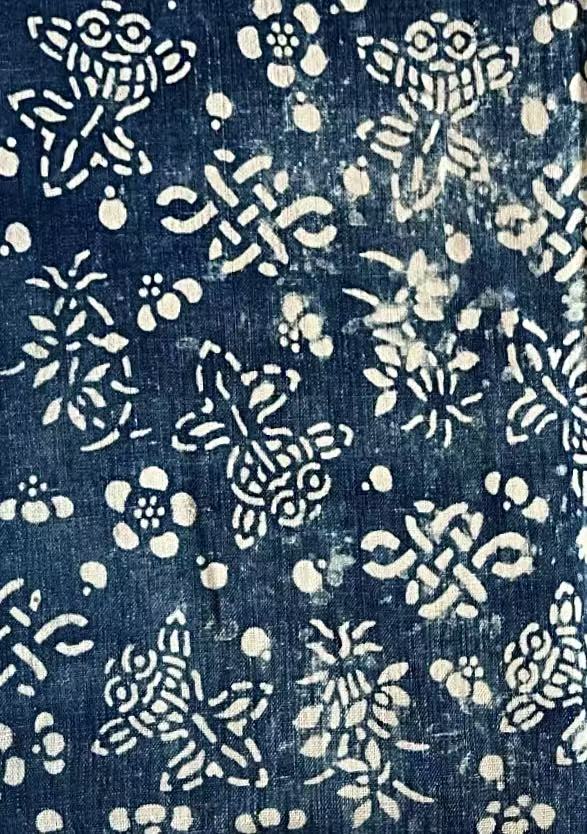
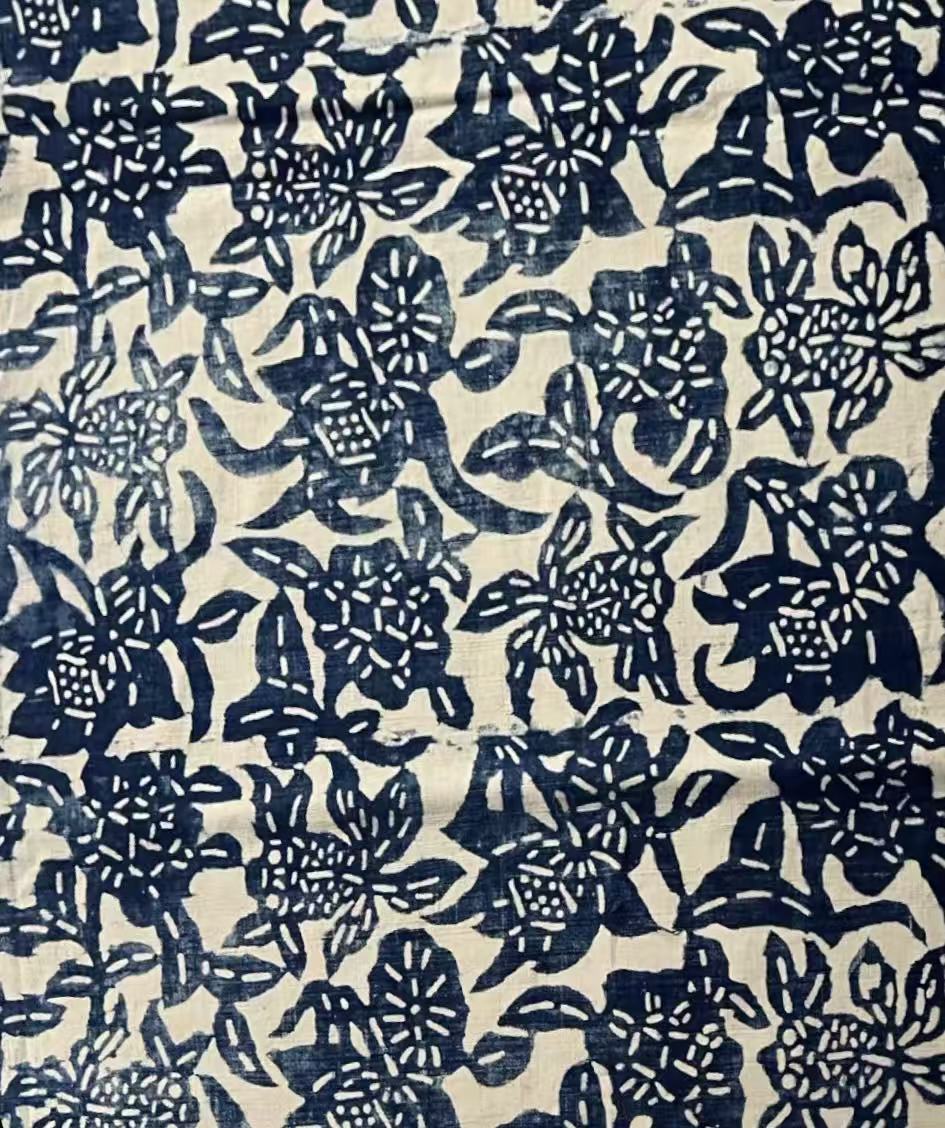
These additional photographs are presented as study references. Lotus Fortune remains the textile with a linked collection record below.
The making of the red-ground Lotus Fortune
For the red-ground Lotus Fortune, the collection record describes hand-spun, handwoven cotton decorated by multicolour hand-stencil printing with oil-treated cut-paper stencils. Colours were applied in separate stages. The cloth has been washed and is recorded as lightweight and soft, with uneven yarn thickness, subtle colour bleeding and irregular print edges.[3]
Those details matter when the textile is seen at close range. The yarns provide a surface that catches the colour, and the printed outlines have gently variable edges. The surviving object lets us study the relationship between a woven ground and the design applied to it.
For more on these processes, see our introduction to Nantong printed cottons and the making of Chinese homespun.
Keeping the composition when making something new
This cloth's record identifies a repeat approximately 45 cm wide and 30 cm long, containing a complete pair of goldfish within the lotus design. That is a useful starting point for planning a small bag panel, textile artwork or patchwork centre.[3]
Before cutting, lay out the intended shape and mark its finished edges and seam allowances. Check where the fish heads, spreading tails and largest leaves will fall. A smaller crop can emphasise the drawing of one fin or leaf; a complete repeat preserves the relationship between the pair of fish and the surrounding flowers.
Photographing the full arrangement before sewing also keeps a record of how the pattern worked across the original cloth. Whether the textile remains in a collection or becomes part of a carefully planned project, its shapes can stay legible: fish moving among lotus, carrying a wish for enough, and for that abundance to continue.
Lotus Fortune in Patchwork Bloom
The goldfish-and-lotus pattern from our red-ground Lotus Fortune · 莲余 cloth is featured in Patchwork Bloom, our textile-inspired puzzle app. We collect and treasure traditional Chinese textiles, and preserve selected patterns digitally so people can explore their colour and detail on screen.
Explore Lotus Fortune and its original photographs →
Sources and further reading
- Hong Kong Palace Museum, “Patterns of Nature, Ingenious Designs and Technology”, section “Fish and Lotus Patterns.” Used for the broader auspicious associations of fish and lotus.
- 《南通蓝印花布》 (Nantong Blue Printed Cloth), Chapter 5, printed p. 172, “金鱼戏莲”. Research copy in the Tubu Atlas reference library. Used for the documented goldfish-and-lotus subject and the wrapping-cloth comparison.
- Tubu Atlas, Lotus Fortune · 莲余, original textile record and photographs, checked 24 November 2026. Used for this cloth's appearance, attributed origin, estimated period, construction, condition and repeat dimensions.
- Tubu Atlas study collection, four owner-supplied photographs received 24 November 2026. These show three comparison groups, including two views of the purple-ground pattern. All are marked as unlisted study references.